



For a manufacturing plant, unplanned downtime is not just an inconvenience. It’s a quantifiable financial event. Production lines stop. Finished goods in process may be scrapped. Equipment restart sequences take time. Delivery commitments to customers slip. Workforce hours are wasted. When you add up those costs across even a few hours of unplanned outage, the number is significant enough to justify serious investment in reliable power continuity infrastructure.
Manufacturing plants are among the most demanding environments for electrical power reliability. They run continuous processes, operate sensitive automation equipment, and in many cases run production around the clock to meet output targets. Any interruption to power supply can trigger a cascade of operational consequences that takes far longer to recover from than the outage itself. A 30-minute power failure in a manufacturing facility can translate into four to six hours of recovery time as production lines are restarted, quality checks are run on in-process goods, and equipment is confirmed operational.
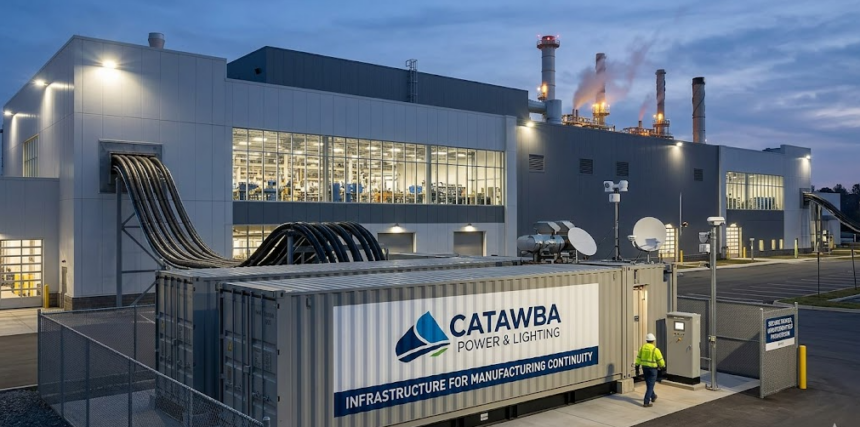
Catawba Power and Lighting serves manufacturing and industrial facilities as one of their core client categories. They provide portable and standby generator systems designed for emergency preparedness and operational continuity, along with commercial-grade switchgear, electrical distribution equipment, and commercial lighting solutions built for industrial environments. Their infrastructure-level expertise and strategic manufacturer relationships mean they understand what manufacturing facilities actually require from their power infrastructure.
What Power Continuity Requirements Are Unique to Manufacturing Environments?
Manufacturing facilities have power continuity requirements that differ significantly from office buildings, retail spaces, or even healthcare facilities. Production automation systems often have specific requirements around power quality, not just power continuity. Voltage sags, frequency deviations, and harmonic distortion can cause programmable logic controllers to fault out, requiring manual reset and restart procedures that eat into production time. Simply keeping the lights on isn’t sufficient. The power has to be clean and stable.
Motor-driven equipment like compressors, conveyors, pumps, and machine tools creates significant electrical load and generates substantial inrush current when starting. A backup power system for a manufacturing facility has to be sized for these startup demands, not just the steady-state running loads. Getting the capacity calculation right requires a detailed load analysis that accounts for the facility’s equipment inventory, startup sequences, and peak demand scenarios.
Catawba Power and Lighting brings the kind of infrastructure-level expertise needed for exactly this type of analysis. Their experience across manufacturing and industrial facilities means they’ve worked through the complexities of industrial load calculations in real project contexts, not just theoretical scenarios.
Why Generators Are the Foundation of Manufacturing Continuity Planning
A manufacturing facility’s power continuity plan can include multiple layers of protection. Uninterruptible power supply systems protect the most sensitive control equipment from momentary sags and brief interruptions. Voltage regulators condition power quality for automation systems. But the foundation of sustained operational continuity is a generator system capable of powering the entire facility or a carefully defined critical load subset for as long as the outage lasts.
Generators sourced through Catawba Power and Lighting are specified for the manufacturing facility’s actual requirements, accounting for the full complexity of industrial electrical loads. Their strategic manufacturer relationships give clients access to commercial and industrial generator products across the capacity range needed for manufacturing applications, from smaller facilities with modest load requirements to large production operations with substantial power demands.
The reliability of the generator itself matters enormously in manufacturing contexts. A backup generator that fails to start when the grid fails, or that shuts down under load due to a maintenance issue, provides no real protection. Working with a distributor who sources from manufacturers with proven commercial and industrial track records, and who supports the procurement process with infrastructure-level expertise, reduces the risk of ending up with equipment that underperforms when it matters most.
How Manufacturing Plants Should Approach Generator Maintenance Planning
Owning a generator is not the same as having reliable backup power. A generator that isn’t properly maintained will fail at the worst possible time. Regular maintenance programs for commercial and industrial generators include load testing under actual operating conditions, not just idle running. They include battery inspection and replacement on schedule because starter batteries are among the most common failure points. They include fuel system maintenance to ensure that diesel fuel, if that’s the fuel type, hasn’t degraded and clogged injectors or filters.
For manufacturing facilities integrating generators into their operational resilience plan, thinking about maintenance from the procurement stage forward is important. This means selecting equipment with accessible service points, clear maintenance documentation, and manufacturer support infrastructure that can provide parts and technical assistance when needed. Catawba Power and Lighting’s focus on building long-term partnerships rather than transactional relationships positions them as a resource for exactly this kind of ongoing support conversation.
What Role Does Lighting Play in Manufacturing Plant Operations?
Manufacturing plant lighting is directly tied to operational performance in ways that facility managers don’t always fully appreciate. Inadequate or poor-quality lighting on production floors increases error rates, contributes to worker fatigue, and creates safety risks around moving machinery and material handling equipment. OSHA workplace safety standards specify minimum illumination levels for different types of manufacturing work, and facilities that fall below those standards create legal exposure alongside operational problems.
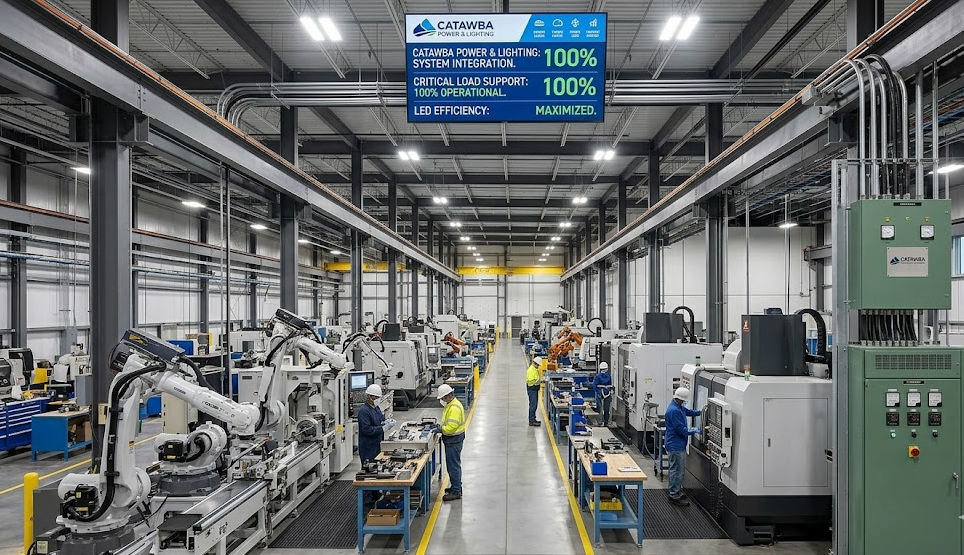
Modern industrial LED lighting systems address these concerns comprehensively. They deliver consistent, high-quality illumination at the work plane from high-bay mounting positions. They maintain their output over years of operation without the lumen depreciation that affects older technologies. They reduce energy consumption substantially, which matters for manufacturing facilities where lighting can represent a significant fraction of total electrical load.
Catawba Power and Lighting delivers commercial and industrial lighting systems from a network of over 150 manufacturers, covering the full range of manufacturing facility lighting applications from production floor high-bays to exterior facility lighting and office support spaces.
Real-World Scenario: Food Processing Plant Power Continuity
A food processing plant operating 24 hours a day faces a specific challenge: power interruptions don’t just stop production. They risk product spoilage in temperature-controlled areas, create food safety compliance issues if sanitation systems are interrupted, and may require costly product disposal if in-process goods exceed safe temperature or time limits without the power to maintain required conditions.
For this facility, backup power isn’t just about protecting equipment and revenue. It’s about food safety compliance and avoiding product losses that can run into significant dollar amounts per incident. A properly specified standby generator system that keeps refrigeration, sanitation, and processing systems running continuously during grid failures is an essential component of the plant’s food safety management plan.
Manufacturing plants working with Catawba Power and Lighting can source generator systems specifically suited to their operational requirements, backed by the distributor’s experience across manufacturing and industrial applications and their commitment to competitive procurement, reliable timelines, and performance-driven solutions.
Conclusion
Manufacturing plants face power continuity challenges that require more than a commodity generator purchase. They require a distributor who understands industrial load requirements, has the manufacturer relationships to source appropriate equipment, and brings the infrastructure expertise to ensure the complete backup power system works as designed when the grid fails. Catawba Power and Lighting delivers all of that, along with nationwide project support, direct-ship distribution capabilities, and a genuine commitment to long-term partnerships. For manufacturing operations of any scale, protecting production continuity starts with the right power infrastructure partner.
FAQ
Q: Why is generator sizing especially complex for manufacturing facilities? A: Manufacturing facilities have large motor-driven loads that create high inrush currents at startup, in addition to automation systems with power quality sensitivity. A detailed load analysis is essential to size the generator correctly for both startup and steady-state demands.
Q: What maintenance practices keep industrial generators reliable? A: Regular load testing under operating conditions, battery inspection and replacement, fuel system maintenance, and scheduled service of all mechanical components are essential to ensuring generator reliability in manufacturing environments.
Q: Does Catawba Power and Lighting serve manufacturing and industrial facilities? A: Yes. Manufacturing and industrial operations are among the core client categories Catawba Power and Lighting serves, alongside tribal governments, casinos, healthcare facilities, emergency management committees, and commercial developers.